
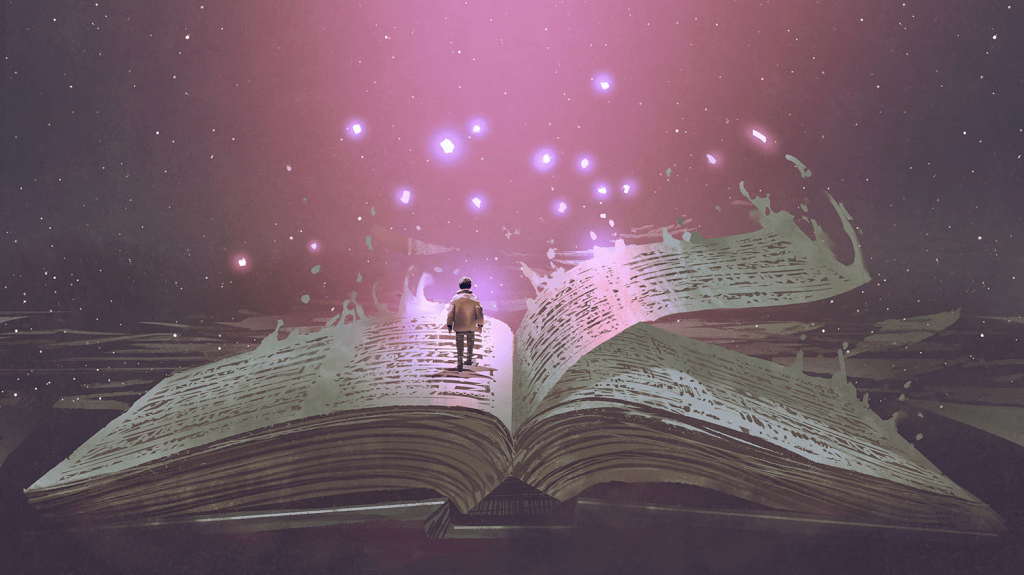
Welcome to the creative rabbit hole known as worldbuilding: the prep work that gives you an endless stream of ideas, inspiration, and sometimes a mild headache.
If you don’t know where to start—don’t worry, neither do I. But let’s figure it out together.
The backbone of everything you hope to accomplish starts here, and that can be intimidating. You might even know your plot before your setting, which is perfectly fine, but the story still needs somewhere to unfold. Somewhere to build immersion, provide logic and consistency, and even influence the story you’ve imagined. So what exactly do you need to build a world?
Let’s break it down into categories that frame our world. With some unavoidable repetition.
Who: The Inhabitants
Every story needs characters, and every character must come from something.
- Are they human, alien, magical, artificial?
- What cultures exist?
- What do they value?
- How do they relate to their environment?
Some of these questions will come up again later—a person is often a product of their world. Building them begins with building where they come from.
What: Magic & Technology
A story’s core usually falls into one of these two categories—sometimes both if you’re crafty.
- How does the magic system work (if any)?
- Is it soft magic (mystical) or hard magic (defined by rules)?
- What level of technology is available?
- How do magic and tech interact—or conflict?
Establish something that reflects or compliments your premise. Spaceships would feel very out of place at a wizard’s college…maybe.
When: Timeline & History
If you’re writing in the real world, time periods make major differences—and that applies just as much to fictional worlds.
- Is this a medieval fantasy? A post-apocalyptic wasteland? A solar punk future?
- What major historical events shaped the world?
- How long has magic/technology existed?
- Are you using a real-world calendar or inventing your own?
Once your world’s core is created, the passage of time can manipulate it in powerful ways. Maybe you imagined a vibrant magical society—but you’re telling a story about the wasteland that remains.
Where: Geography & Setting
The most straightforward question really—what does your world look like?
- Continents, islands, cities, ruins, floating mountains?
- Climate zones: frozen tundras vs. sweltering jungles
- Unique landmarks: magical forests, cursed lakes, sky cities
- Travel and transportation
Imagery is what readers hold onto from the first to the last page. Nothing else matters until the vision we’re meant to see materializes.
Worldbuilding: Politics, Religion, Society
Now that the theoretical shell has been built—how do the inhabitants interact with their world?
- Who holds power, and how is it maintained?
- What ideologies dominate society?
- Are there political tensions, alliances, or civil unrest?
- What role does religion play? What is religion?
These are the veins running between everything else in your system—the life breathed into the bones you’ve crafted. They’re the odds stacked for and against your protagonist as they take on their adventure.
- How does geography shape conflict?
- How important is education, art, fashion, or food?
- How do cultural beliefs challenge your protagonist?
- Could magic’s limitations create moral dilemmas?
Take your time making these choices. Change them a hundred times. Let your world evolve and surprise you. The deeper you dig, the more real it becomes—not just for your readers, but for you.
And when in doubt, remember: You don’t have to build everything at once. Start with what matters to your story and expand from there.
 Alyssa B.Newbon
Leave a comment