I have received most gracious words from some old companions in the capital!
His Majesty has allowed The Annual Larkspur Baking Festival to continue after this harvest.
Perhaps you remember from your studies, Larkspur is home to a host of notorious witches. There is much to be learned and much more to be tasted. These women have cultivated one of the strongest coven-cities on the continent—and they rely heavily on tourism to thrive.
The festival draws artisans from every province. Pies that predict weather, breads that remember the hands that kneaded them, cakes that sing in three-part harmony! I believe it would be an unforgivable sin to pass by without attending the festival.
More importantly, the Grand Coven will be in attendance. Observing them in their element would be an education impossible to replicate in any library.
Do bring an apron and an open mind. The ovens are said to test more than pastry skill; they test character. Larkspur may rise to meet you in ways you don’t yet expect. Naturally, I expect a full report.
Your devoted mentor,
Orlin the Wise Sorcerer Supreme, Fifth Crown Appointee In Service to the Archive and the Realm
ARCHIVE ENTRY #022
Title: “Three Witches Walk Into a Bakery”
Filed by: Estella Wormwood, Apprentice of Orlin the Wise
Date: 9th Embermonth, Year 623
Location: Larkspur
Security Level: Watchlisted (Coven Eyes Only)
—
What began as a local bake-off rapidly escalated into a magical power struggle laced with frosting and soul stealing sourdough.
If this entry smells faintly of burnt sugar and betrayal, that’s because it is.
Signed,
E. Wormwood
(Note: Remiss to share: no autographs or quotes were collected from legends in attendance. We are determined to try again under less dire-dessert circumstances)
—
The Larkspur Annual Baking Fair was—according to the wagon’s travel log—‘mildly competitive, deeply floury, and only fatal in two recorded instances.’…Estella arrived late.
By now the stone square was dusted in powdered sugar and trepidation. Frosted banners fluttered in the breeze—tables bowed under golden pies—and in the center of it all stood three familiar women, each more dramatically dressed than the last.
She patted Orlin’s letter, weighing her breast pocket—just once more, and started for them.
The matron on the left wore a sharp, red-lipped smile and an apron embroidered with thorns and curses—Morrigane Hawkesweed. Her taloned fingers held the brim of a large black hat, its curling tip nearly matching the height of the maiden beside her.
Lilliana Thistlewhip’s lithe form floated in a dress that glistened like summer jam, a bonnet of swirling cream atop her head. Auburn hair spilled down her shoulders like syrup poured from a bottle.
And the crone—Magis Briarwitch—a friend of Orlin The Wise, and head of the Grand Coven. She wrapped her curved spine in something that reeked of remains and radiated enough disdain to curdle cream.
Only now did the parchment over her chest reveal its true meaning. This strange sweet tooth request was in fact a chance to stand before the Grand Witches…with no time to prepare. In true Orlin fashion.
Estella straightened her coat and spine then took one step onto the cobblestones. She immediately sneezed.
The sneeze sparked a nearby cake that exploded into marzipan butterflies. The crowd cheered.
“Oh, lovely,” she muttered, brushing powdered magic from her sleeves. “It’s that kind of baking fair.”
The three witches across the square turned as one. Estella moved swiftly, hoping the air would cool her burning cheeks. Morrigane’s hat tipped just enough to hide her grin. Lilliana swirled her cream bonnet with a flick, as though savoring the spectacle. And Magis’ sigh rolled out like a cold draft from a tomb.
“Ah, golden eyes. I wondered when Orlin would send the fawn,” said Lilliana.
“Tell the old croak, the Oven keeps better time than the court. And his pupil was late.” Magis added, this time to Estella—who now opened her mouth to apologize,
“Truly sorry, the wagon wouldn’t enter the city with this crowd. Master sends his regards. The Crown keeps him quite busy these days.”
Morrigane sneered at that.
“The Crown thinks it can regulate magic,” the shadows cast by her brim began to grow on the cobblestone. “The Oven laughs at kings you know. Let’s see if you can make it laugh.”
“Pardon?” asked Estella.
All three witches gestured toward a half crumbling, brick and mortar bakery to their left. Estella craned her neck to watch the large plumes of purple smoke spill from the chimney.
“Contestant!” someone barked from the crowd.
Before she could look down, a whisk smacked into her palm with the force of destiny—or at least of poorly supervised kitchenware. Then there was a smaller frantic looking witch beside them.
“Wait—no—this is a misunderstanding.” Estella sputtered, trying to shove it back at the official. The whisk clung, handle curling around her wrist like eager ivy.
A cheer rose from the crowd. Someone hurled a puff pastry bouquet in her direction. It burst into pigeons midair. Morrigane snickered again while Lilliana hid her smile behind a gloved hand.
“This isn’t—!” she began again, but her words drowned beneath the ring of a bell and the scrape of chalk across slate. Her name was being scrawled into the contestant roster in glowing sugar script. She turned a confused and pleading expression to Magis—who only stared through her.
“Contestant!” the squat witch barked again, yanking Estella by the elbow.
“No, really, I’m—”
But her protest collapsed as she was shoved through a flour-dusted curtain, leaving the fair—and her chance with the Grand Coven—behind.
—
The air changed at once—cooler, heavier, infused with almond smoke and a hint of doom. The crowd’s roar vanished in an instant, as if she had stepped through a pie crust and into another world.
“Name?” asked another witch with a clipboard and a quill that smoked ominously.
“Estella. But I’m not—” She tried to make out her surroundings through adjusting eyes.
“Great. You’ll be Station Ten. Watch out for Station Nine; she bakes with feelings.”
“Wait, I—” A bell rang and the ground rumbled.
The Oven behind her groaned like a dragon with indigestion. Its massive looming form occupied more than half the space. This was some kind of kitchen. And she was now, unwillingly, part of a ritualistic bake off.
“Begin!”
Estella sighed and looked down at the whisk. It blinked back at her.
“Oh good,” she said, remembering last week’s spat with The Kitchen. “Sentient utensils. What could possibly go wrong?”
She paused only to take a breath. The sweet aromas from each station combined and assaulted her nose. Something sugary, nutty, and a little…electric—magic. Estella gathered that this would not be any sort of normal competition.
Station Nine was indeed baking with feelings.
“I call this ‘Lover’s Regret,’” the witch crooned, pouring viscous heartbreak custard into a crust lined with crushed lavender. Her apron read Break Me, Bake Me, Bind Me in stitched thorn script.
Estella’s station wheezed like an asthmatic accordion as the smaller ovens flared to life. She peered around the room once more. Ten small prep stations were situated in a circle around the large hearth. Across the floor, Station Three coaxed a lump of dough that insisted on standing upright and flexing its gluten.
“Bread golem,” the witch announced proudly. The golem saluted, then attempted to escape across the counter.
On her other side, Station One’s meringue was reciting tragic poetry in a falsetto.
Someone shrieked as a cauldron of caramel began orbiting the chandelier like a molten moon. A choir of cupcakes somewhere were harmonizing. Every clang of pan or spoon carried a faint echo of laughter—as if the kitchen itself enjoyed the chaos. Estella tightened her grip on the sentient whisk.
“Comforting,” she muttered, starting to measure out anti-anxiety jam while dodging a runaway bread roll.
By the time she’d cobbled together something vaguely resembling a tart with a filling of the jam and one very rude cinnamon stick, Estella had gathered several facts:
This was not a baking fair, but a selection rite. Naturally. The winner would be named High Witch of the Threefold Crust. And the losers—would be banished from Larkspur, the only place a witch could practice magic.
“Three witches walk into a bakery,” Varric muttered from the edge of shadows behind the butter churn. “Sounds like a joke. Ends like a tragedy.”
Estella jumped, eyes darting around the room before they landed narrowly on him.
“How did you—I didn’t volunteer for this you know,” she hissed, failing to wipe the flour from her face. “Someone conscripted me!” Hairs danced between her antlers at the outburst.
He browsed the other contestants and sniffed the air. “Uh oh, that one’s cursing the nutmeg. You’re in trouble.”
“Oh please. I study under Orlin the Wise. I can taste a hex blindfolded with a stuffy nose.”
A second later, her tart exploded—and the rest of her hair fell from atop her head.
“Okay,” she brushed the charred crust from her sleeve, “maybe half a hex.”
Varric retreated to the shadows with a smile. Leaving Estella to her defeat.
—
Soon Estella watched as the other witches began offering their creations to The Oven. A small crowd had formed around the hearth to watch the judgment. She could make out the three familiar silhouettes along the back wall.
Magis Briarwitch and her companions had come. Just in time to see Estella, and the finale.
Station Nine crafted an emotional soufflé that sighed with existential dread. Five had baked a casserole that sang hymns to the harvest moon and wept gravy. Three was still busy glazing her cupcakes while they blinked back at her.
The Oven loomed like a cathedral, brick throat glowing with hunger. She could only bear witness as dish after dish was turned away, or completely burned in rejection. Every step toward it became a prayer and a gamble.
Estella, thoroughly annoyed and utterly exhausted, had resorted to sourdough. But not just any sourdough. She needed something to win. “The Bread of Binding,” she’d read aloud from the ancient cookbook Varric had stolen from the Archive’s Restricted Pantry. A stunt she would most likely pay for later.
Infused with memory. Tempered with intent. Risen with soul.
It pulsed. She’d named it Gerald—and staked her livelihood on his complex charm.
“You are the last group,” the announcer called over the crowd, teeth gleaming like fondant knives. “Present your offerings to the Oven.”
It was not a metaphorical oven. It had a mouth…and opinions. Estella’s sourdough loaf—Gerald—trembled in her arms.
“I feel like this is wrong,” he murmured.
“You’re a sentient carb,” she said. “Your entire existence is morally ambiguous.”
Station Nine approached first, souffle oozing in its ramekin. It beat faintly, like a heart too tired to go on. The Oven…sniffed—drawing air in through unseen vents. A shiver ran through the crowd. Flames licked higher, then sank, as though the taste did not satisfy. Her eyes filled with the same dread her dish carried.
The witch’s face paled. She hurried to collect her plate from the slab before being escorted out with the others.
Station Five trembled as she bowed. Her casserole wept audibly, gravy dripping onto her shoes as though begging not to be sacrificed. The Oven gurgled deep in its belly. For one brief, hopeful moment the embers flickered green, like harvest fields—then its gentle melody was strangled. Flames burned it black, ash curling where gravy tears streamed.
Rejection was absolute.
The last witch, Station Three, raised her cakes like a relic. She placed them gently on the hot stone. The Oven sat—unchanging. Until, one by one, the cakes sparked like candles. Only to be snuffed out in a storm of black smoke. Her tray clattered to the floor as the Oven rumbled its disapproval.
Then came Estella. Gerald quivered in her hands, crust warm beneath her palms. She willed down the nausea threatening to surge.
“I don’t like this,” he whispered, his voice a low yeasty hum.
“You don’t have to like it,” she whispered back. “Just…don’t embarrass me. And don’t scream,” she paused for a moment. “Or, at least—if you do, harmonize.”
Eye-like coals fixed on them both. The crowd leaned forward. Even the three witches in the back row had stilled, their ranks momentarily forgotten as they waited for the final judgment to be passed. She set Gerald down gently and patted his crust.
The Oven inhaled again. The air warped with heat. Sparks scattered like fireflies. Gerald trembled, then puffed up his crust proudly. He had not been scorched…yet.
“I am perfectly fermented,” he declared.
A silence fell so thick Estella could hear her own pulse. Then, slowly—reverently—the Oven exhaled, a breath of molten butter and iron. Its doors closed with little ceremony, sealing Gerald inside.
Estella tore her attention from her loaf to scan the crowd again. The witches all wore different expressions—confusion, shock, disbelief, and along that far wall, three mildly impressed faces.
For an eternal second, nothing—only heat, only dread. She didn’t dare celebrate. Until a voice, resonant and rich as brioche, thundered from the building itself:
“She is the Crust Chosen.”
Some of the witches fainted.
—
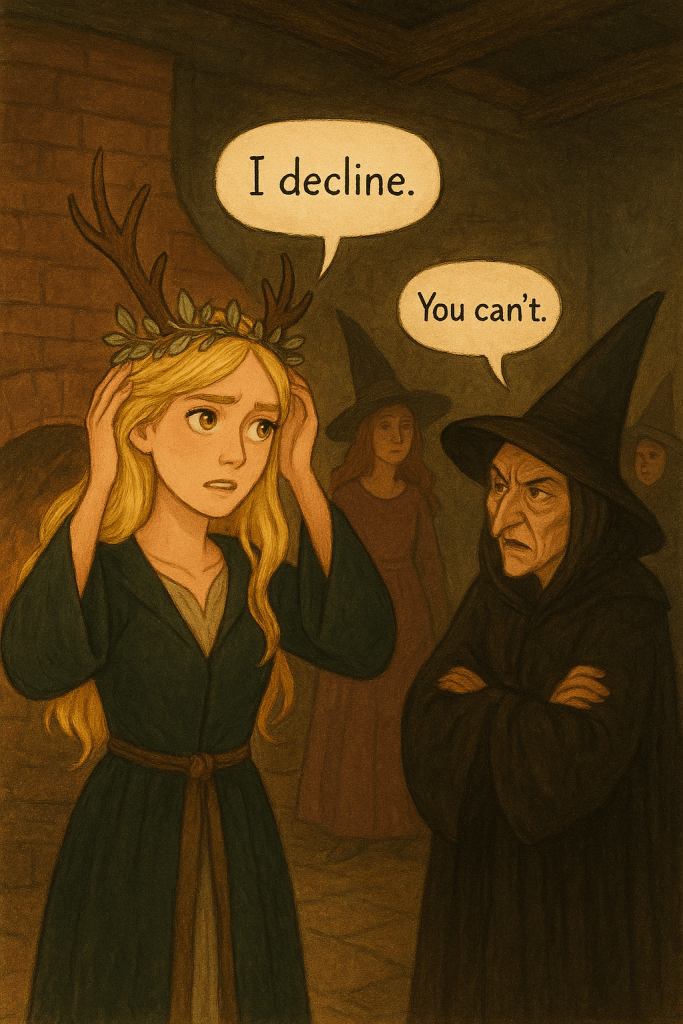
Estella was crowned with a wreath of candied sage not a moment later. The cheers began.
“I decline,” she said immediately. The cheering was cut short as a bottle popped somewhere. Someone cleared their throat in the silence.
“You can’t,” called Magis from the wall.The sea of witches parted for the crone as she approached Estella, Lilliana and Morrigane on her heels. Each step echoed.
“I don’t want to be in charge of a coven full of deranged pastry chefs.”
There was a unison gasp before the circle began to stretch away from Estella. They whispered to each other in disbelief.
“You won, dear.”
“I didn’t even know I was entered.”
The Grand witches all shared a look like they knew something she did not. Estella couldn’t help but think of a reason—Orlin.
“The Oven chose the one who performed best and fed it without fear,” Magis said.
“Choice is a luxury, dear. Leadership is a calling.” Lilliana added gently.
The sage crackled like a hearth, heat sinking into her scalp until it hummed in her bones. Leadership smelled of warm bread and scorched sanity. It was heavier than any spellbook.
“Well I had hardly anything to lose compared to the others.” Estella argued.
“They have spent their whole lives in these kitchens. You faced the unknown without fear.” Magis’ features were wrinkled at the edges. “Do you think the Oven is wrong?” Her eyes glinted. “Or is it that you do not take us seriously, young sorceress?”
“Apprentice.” Estella corrected carefully, trying not to offend a room of powerful witches any further. None of them moved.
She could not accept the weight of two mantles in one day. She should run, but somehow the thought of Gerald, of every dough and dream in this city, kept her feet still.
The crowd was still holding their breath as Estella surveyed them all.
Suddenly, a young witch in the front, no older than thirteen, stepped forward. She was clutching something tightly in her hands.
Estella smiled at the girl. Everyone watched as she knelt down and extended her hand. The girl floated forward. She stared into Estella’s golden eyes and opened her fist—in her palm was a small string of beads, and dangling on the end was a metal coin. The insignia of The Threefold Crust embossed on the surface.
“Will you… please teach us to bake like you?” The girl asked with her small shaking voice.
If the Oven, these witches—if Orlin—truly thought her fit, she could at least try. More children pressed forward with small offerings—how could she say no now?
“Okay.” Estella dropped the girl’s hands and bowed her head. “I can teach you what my master taught me.”
The children lit up brighter than the flames in the hearth, closing in around Estella to twirl her hair and poke her antlers. Magis and the others watched silently, spines straight with pride.
“You should ask about the benefits first.” Varric added, leaning against a larger bread golem—munching on its hand. It watched in silent shock.
Estella’s head whipped toward the arrival of his cinnamon scent. She sighed, laughed, and tore a finger off for herself.
The Threefold Crust held a celebration that night and Estella learned one last thing about the witches of Larkspur—they knew how to party.
—Archive Note: ‘Temporarily inherited the title of High Witch, which comes with a spoon scepter and a mildly cursed teapot that predicts brunch disasters. The sentient loaf known as Gerald will be fondly remembered.’
By decree of the Briar Crown, I, Orlin the Wise, Sorcerer Supreme, have departed the royal court to retrieve and catalog lost Fae artifacts spanning centuries past. I leave behind my trusted colleagues to serve the throne in my absence.
As a parting gift from the Grand Witch’s Coven, I have been granted ownership of an enchanted wagon—reportedly endless in its internal structure and mildly sentient. I’m told it has a tendency to rearrange itself when displeased. We shall see.
In addition to my personal effects and research materials, I travel with two fae-touched companions whose names must be entered into official record:
Estella Wormwood, female, 18 years of age. Blessed in infancy by yours truly. Her servitude is the agreed repayment for said blessing, and she now serves as my apprentice. She displays strong affinity with her Fawn spirit—curious, agile, soft-hearted. Promising talent.
Varric Skell, male, approximately 115 years of age. Blessed by an unidentified fae during adolescence. I have granted him asylum in exchange for his service as our protector. His bond with the Coyote spirit is… unnerving. Pay close attention.
My inventory includes, but is not limited to: a complete herbarium, over four hundred tomes and arcane volumes, and a population of 327 living creatures—both magical and mundane.
The wagon is, as advertised, generous with space and unusually maternal in temperament. The children are regularly bathed and fed without my involvement. I am inclined to consider this a net positive.
As I will not return to the kingdom until either my expedition concludes or my successor is named, I submit this report to mark the beginning of our endeavor. The latter condition may come sooner than expected—my intuition, though aged, remains sharp.
Estella advances daily. She is tireless, empathetic, and gifted. Should the gods smile kindly, I believe she may one day wear the mantle of Sorceress in her own right.
Signed, Orlin the Wise Sorcerer Supreme, Fifth Crown Appointee In Service to the Archive and the Realm
ARCHIVE ENTRY #017
“The Turnip That Knew Too Much”
Filed by: Estella Wormwood, Apprentice of Orlin the Wise
4th Bloomtide, Year 623
Location: Turnwell Village
Security Level: Moderate
—
Sir. Rudius(Rudy) Baga
This record details the events involving a sentient root vegetable, a disgraced village, and an attempted sautéing by one Varric Skell.
Filed for posterity and the next poor apprentice visiting Turnwell.
Signed, E. Wormwood
(Note: Bestiary has added “Cognitive Vegetables” as a new subsection.)
–
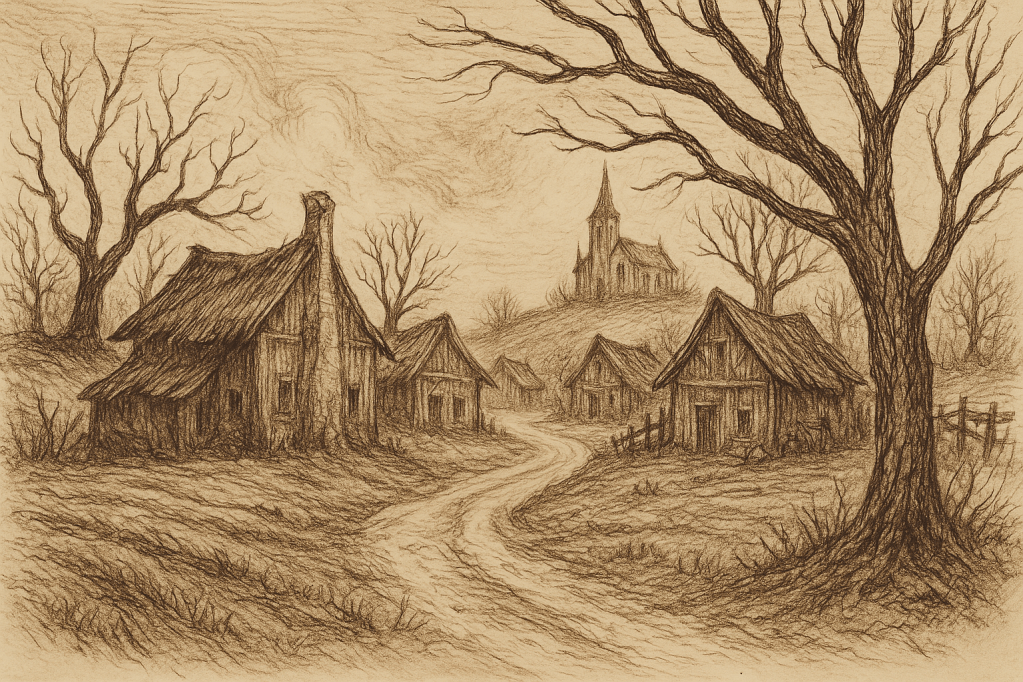
Turnwell was usually the sort of place where a wagon’s arrival brought out half the town—baskets in hand, children chasing chickens, someone always shouting about stew.
Estella was not greeted with the usual fanfare.
The cobbled streets remained empty, dust and dirt undisturbed. No boisterous children played in the clearings. Even the livestock, usually noisy and nosy, stood oddly still in their pens, blinking like they’d forgotten how to chew.
She turned back to the wagon. “Are you sure this is the place? Seems like no one’s home.”
The wagon groaned and snapped its curtains shut in offense. Estella raised her hands in surrender. A lock clicked behind her. The lantern hanging from the canopy flickered, then went out.
“Fine. Message received.”
Estella sighed and adjusted the satchel on her shoulder. “Right. Exploring the haunted farm village it is.”
Turnwell’s silence wasn’t just unsettling—it was suspicious. It had the feel of a place that knew it was hiding something. She walked on, the soles of her boots the only sound echoing off the shuttered windows.
It took half an hour and two false turns before she found someone—a wiry man perched on the edge of a crumbling fence, straw hat pulled low, pipe unlit.
“Afternoon,” Estella said, friendly as she could manage.
The man blinked slowly, like he hadn’t spoken to another soul in weeks.
“You with that… thing?” He gestured vaguely in the direction of the wagon, as if afraid it might hear.
“That thing has a name,” Estella said. “But yes.”
He grunted.
“I’m Estella. Apprentice to Orlin the Wise. I was hoping to offer some assistance. Maybe trade. I hear your fields have gone barren.”
The man tensed. “No one said that.”
“You haven’t harvested in two seasons.”
His jaw clenched.
Estella smiled, gentle but persistent, pulling some parchment from her satchel. “I’d be happy to take a look. We’ve got supplies. Potions, enchanted compost, sunstone mulch—”
“No need.” He stood abruptly. “Land just turned on us. Happens. You can’t fix dead earth.”
“You’d be surprised,” she said, tone still light. “Magic’s full of rude awakenings.”
He narrowed his eyes, finally noting the antlers poking out from her head. “Don’t go nosing around. The land’s cursed is what it is. Nothing natural grows there anymore. You’ll get yourself turned inside out if you meddle.”
“Noted. Just offering to help.”
He spat into the dust. “You want to trade, trade. Otherwise keep to the road.”
Estella bowed her head just slightly, writing “Curse” under Suspicious Deflection, and turned to leave.
—
The village was a few paces behind her when she caught the scent—fresh soil, blooming mint, something vaguely nutty and… buttery?
Estella paused.
To the east, just beyond a thicket of dry hedgerow and a bank of turned soil, the village’s supposed “cursed land” spread out like a forgotten dream. Fields—lush, thriving, unreasonably green—sprawled across the low valley. Cornstalks taller than men bowed in the breeze. Vines thick with blossoms choked old stone walls. Something glowed faintly in the furrows.
“Right. Very cursed,” she muttered, ducking through the hedge.
She didn’t get far before her boot nudged something unusually firm in the soil.
It yelped.
“Good heavens, watch the leaves!”
Estella stumbled back.
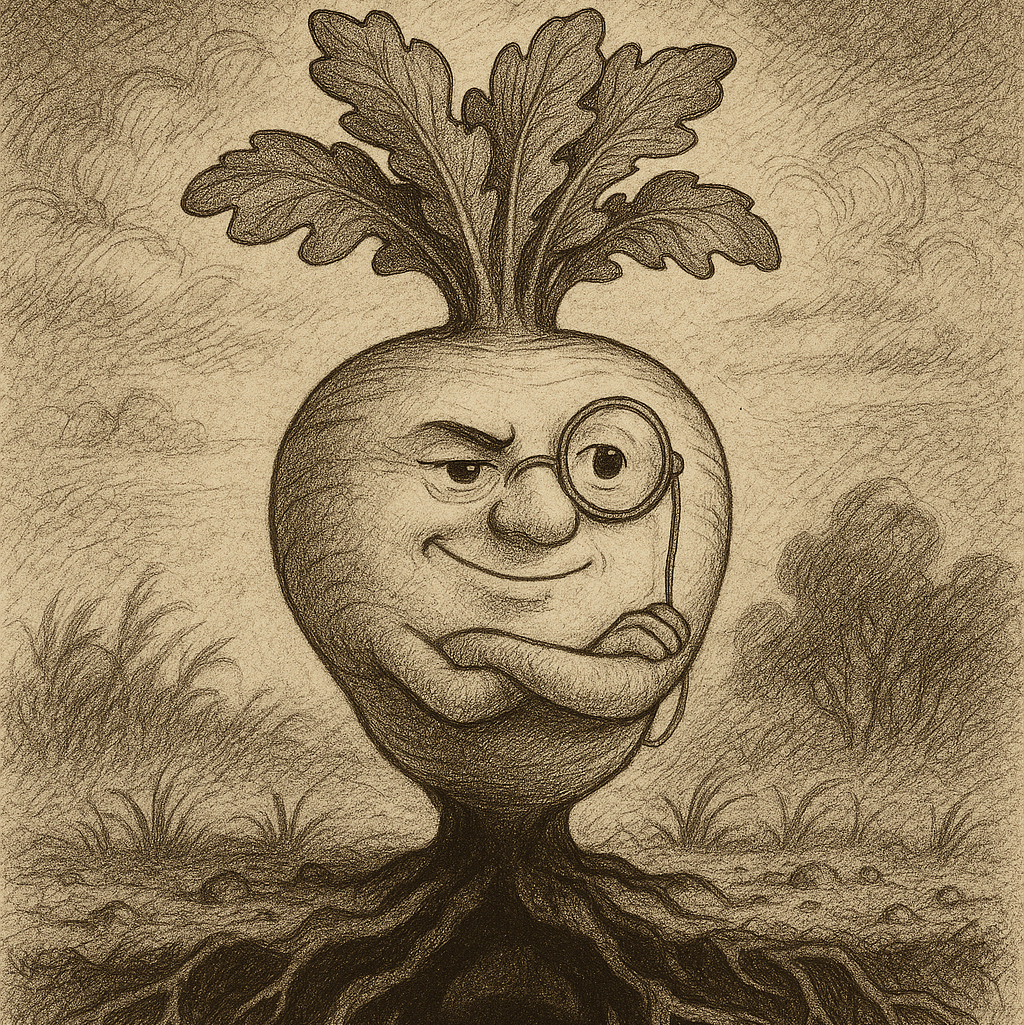
There, halfway unearthed in the garden bed, was the face of a turnip. A very annoyed, very expressive turnip, with delicately furrowed brows and a ridiculous monocle jammed over one golden eye.
“I say, finally someone with manners,” it huffed. “Do you have any idea how long I’ve been stranded among these buffoons? If I have to hear one more cabbage scream about root rot, I swear I shall compost myself out of sheer boredom.”
Estella crouched slowly. “…Are you enchanted?”
“Enchanted?” The turnip sniffed. “No, madam, I am ennobled. I am Sir Rudius Baga, heir to the Verdant Vale, fifth son of Duchess Marrow of Carrotria. And you—” He paused, squinting at her golden eyes. “Oh! You’re fae-touched. Delightful. That explains the cheekbones.”
“I have so many questions.”
“And I shall answer all of them, in excruciating detail—over tea. Chamomile, preferably. Loose leaf. With honey. I’ve been eating nothing but soil and gossip for three weeks.”
“You eat gossip?”
“Figuratively, dear girl. Though I did nibble on a radish who claimed to be a reincarnated queen. Terribly spicy.”
—
Estella soon found herself sipping lukewarm tea, seated at a table outside the wagon, asking questions to a turnip…wearing a monocle. Rudy insisted on real porcelain, which he claimed “heightens the bouquet,” though he had no nose and couldn’t drink.
“I must say,” Rudy drawled, “I do appreciate the civility. Most peasants I’ve spoken to simply scream. Of course, the villagers here were so grateful for my blessings. I advised them on crop rotation, pest management, a few simple rituals—just the basics!”
Estella stirred her tea. “Has anyone tried to cook you?”
“Oh, please. I am quite charming company.”
From the wagon steps, Varric snorted. “Charming doesn’t sound like moldy cheese with a superiority complex.”
Rudy gasped, his leaves wilting in offense. “You again! You unwashed slab of fur and bad decisions! Of course you’ve found a new hand for your leash”
“Still want to roast you.”
“You tried to pair me with rosemary, you barbarian!”
“I was hungry. You were annoying.”
Estella nodded to herself, agreeing with her own assessment. It’s not shocking to hear of their history given his former employment to another sorcerer. And if it were anyone, it would certainly be a young Varric.
“Touch me and I’ll tell everyone about the time you cried during that symphony.”
“It was a good song,” Varric growled.
Estella pinched the bridge of her nose. “Enough. Rudy, you said they used to bring you tributes?”
“Gifts,” Rudy corrected. “They brought me gifts. You must understand, I was their spiritual advisor. They came to me for agricultural counsel, relationship woes, the occasional weather dispute… Naturally, gratitude flowed.”
“They buried things at the edge of the field?” Estella asked.
“Oh yes, quite the odd habit,” Rudy said breezily. “Maybe it was ancestral reverence. Or perhaps they thought I was lonely.
Estella stared at him. “You’re telling me you didn’t ask for sacrifices?”
“I never said ‘sacrifice.’ That’s such an ugly word. But one day, the mayor brought me a chicken. Honestly, I said nothing! I assumed it was a cultural thing.”
Estella scribbled furiously in her journal. Rudy was humming what sounded suspiciously like a baroque waltz from his spot in a tea tin.
That night, the Bestiary refused to house him. The Kitchen tried to slice and serve him. The Archive had let him alphabetize himself under “N” for “Nobility.”
She was going to need to file several new categories after this.
Archive Note: Sir Rudius Baga is not a vegetable, he insists. “I am an entity,” he said, “of considerable depth and social importance.” Proceed with caution. And perhaps silverware.
—
The next day, Estella found the farmer where she’d left him: hunched on that same splintered fence, pipe still unlit, watching the empty road like it might bite him.
He didn’t turn when she approached.
“You again,” he muttered. “Didn’t take the hint yesterday?”
“I’m persistent,” Estella said, folding her hands behind her back. “And curious. The field to the east—lush, green, glowing in a vaguely suspicious manner—you say it’s cursed. But you also say nothing grows.”
He didn’t answer.
“So.” She paced slowly in front of him. “Help me out. Is the land dead, or unnaturally thriving?”
The man spat into the dirt again. “It’s both.”
Estella tilted her head. “That’s not how dirt works.”
“That’s how he works.”
A pause.
“…You mean Rudy.”
He flinched at the name.
“I knew it,” she said quietly. “What is he?”
The farmer’s eyes, bleary and bloodshot, finally met her golden gaze. “He’s hunger. Wrapped up in charm and leaves and lies. We brought him here with a bargain we didn’t understand. Should’ve known better than to make deals with the Fae.”
Estella’s heart sank a little. “What kind of bargain?”
He hesitated. Then stood, motioning with two fingers. “Come on. You want answers, you’ll get ‘em. Just don’t touch anything.”
—
They walked in silence through the old orchard, past a moss-covered well and a rusted plow swallowed by roots. At the edge of the lush field stood a half-collapsed tool shed.
Inside, behind moldy sacks of seed and a shelf of bone-dry potions, the farmer lifted a false wall to reveal a shallow pit—lined with old stones and offerings long abandoned. Half-buried in the center was a pile of yellowed bones, crusted with dried mint and something darker.
Estella crouched beside it.
“This was… the mayor?” she asked softly.
The farmer nodded. “Got it in his head, Rudy was divine. Said the turnip whispered in his dreams, told him how to fix the crops, save the village. Said we owed him.”
“And you believed that?”
“We were starving,” he said. “For a year, not a drop of rain. Half the livestock died. Folks were digging up bark and chewing moss. When the fields came back… we didn’t question it. Not ‘til we realized the cost.”
Estella touched the blunt head of a femur, feeling a faint thrum of residual magic—old, tangled, wrong.
“No one’s fed him since,” the farmer said. “No one dares. But we couldn’t pull him up, neither. He was rooted deep.”
She stood. “What do you feed him?”
The farmer didn’t answer. Outside, the corn rustled ominously, though there was no wind.
—
Back at the wagon, farmer in tow, Rudy was humming a lullaby and organizing sugar cubes by pyramid height.
“Oh, there you are,” he chirped. “I’ve been thinking of new ways to aid the harvest. Have you considered the possibility of a spring festival? I could draft invitations.”
Estella set down her satchel, in no mood for his courtly machinations, “You were brought here by a Fae bargain.”
“I was invited,” Rudy said with a sniff. “Summoned, technically. Which is rather impolite if you ask me.”
“You eat life force!”
“Eat is such a vulgar word,” Rudy said. “I… incorporate it. Redistribute it. Very economical.”
“You’re the reason this place is dying.”
“I’m the reason this place lived,” Rudy snapped, his leaves twitching. “I merely… suggested methods. Efficient ones! What’s a little blood for a banquet of golden grain?”
Estella exhaled slowly. “You convinced these people to murder their own.”
“I never asked them to,” Rudy said, looking offended. “They offered. I’m not ungrateful.”
“Rudy,” Estella said, voice low, “they gave up their lives. Their families. Their souls. That’s not a thank-you gift.”
He went quiet. In the shadow of the tea tin, his monocle gleamed faintly. Estella stood for a long moment basking in the flame of her temper, watching the tiny glint of metal and pretense.
“Varric,” she said at last.
He didn’t look up from where he was sharpening a butter knife. “Hmm?”
“Get the tongs.”
The turnip flinched.
—
The farmer didn’t argue this time. He just led her from the wagon, down a side path behind the grain store, past a tree with rope marks too old to be recent and too deliberate to be innocent.
“Tell me the whole deal,” Estella said. “No riddles. No metaphors. I’m fresh out of patience and I’m halfway to conjuring a root rot plague on your entire pantry.”
He didn’t smile. Just exhaled like the words had been stuck in his lungs for years.
“It wasn’t supposed to last. The mayor called him up after the drought—said the earth needed a steward, a caretaker with… deeper roots.” The man winced at his own phrasing. “We thought we were getting a spirit. Got a politician with delusions of grandeur.”
“And the bargain?”
“Life for life. One to start the cycle. One each season to keep it spinning. Blood soaks deeper than water.”
“Nice motto. You wanna put that on the town banner?”
He didn’t answer.
Estella looked back toward the wagon. “Alright then.”
She rolled up her sleeves.
“Let’s remove a parasite.”
—
It took salt, iron filings, a bottle of Varric’s ‘special blend’ whiskey, and the mayor’s old pocket watch—still ticking, disturbingly slow—to set the ritual circle. Rudy sat in the center, placed rather firmly in a soup bowl.
“I feel this is all deeply unfair,” he muttered. “You’re treating me like some common curse. I’m an institution.”
“You’re a moldy root with an ego problem,” Varric said, tossing dried mint into the fire. “And I’m hungry.”
“Touch me and I swear I’ll haunt your seasoning rack.”
Estella didn’t look up from the chalk runes. “Do turnips have souls?”
“Mine is magnificent.”
“I’ll take that as a no.”
The fire flared. The runes burned green, then gold, then a slick, unpleasant color not found in the rainbow. Rudy stiffened.
“No,” he said. “No, no, no. You don’t understand—I improved things. I brought prosperity. You were all so grateful—”
“You ate people, Rudy.”
“I didn’t chew! I’m refined!”
The wind shifted. The cornfield groaned. From deep underground, something growled—a sound like rotting roots and regret.
Estella pressed her palm to the final glyph.
“You’ll regret this, you know,” he croons, voice thick with static and soil. “Your fields will wither. Your stew will be bland. And no one, no one, will ever compliment your compost again—”
“Shut up, Rudy,” Varric mutters. “You’re going in the pot.”
“I revoke the invitation. By sun and soil, by debt repaid and names remembered—I cast you out.”
The soup bowl cracked.
Rudy screamed.
It was not, as one might expect, a high-pitched squeal, but a surprisingly musical baritone—like a disgraced opera singer tripping down a flight of stairs made entirely of accordions.
The earth shuddered. Vines shriveled. The air tasted briefly of overripe nectarines and unresolved tension.
Then, the field returned to silence. Real silence this time. The kind that didn’t hum with suppressed guilt or supernatural gardening tips.
Estella slumped against a barrel.
“Well, that was… unsettling,” She said, rubbing her temples as if to scrub away the echoes of the ritual. “I can’t say I’ll miss the turnip, but I think I might need a drink after that.”
Varric held up a slightly charred turnip. “Still edible.”
“I’m not eating sentient produce.”
“He insulted my stew. That’s personal.”
Now, for the first time since their arrival, she laughed in earnest.
—
The villagers emerged, tentative and sun-starved, blinking at the sky like they weren’t sure it would still be there. Turnwell may not be saved, but it has a future now. The soil is quiet. The kitchen is full. The curse is broken.
A modest celebration unfolded—modest in scale, less so in culinary creativity. The stew was excellent. Rudy, for the record, was seasoned with rosemary.
Estella filed her final note in the Archive entry two days later,
“False Idols and Fae Influence – Subcategory: Root-Based”
“Turnwell will recover. The land’s still shy, but willing. The villagers are planting again—real crops this time. No blood. Just honest work.
As for Sir Rudius Baga: he will not be missed.
Though he was, in fairness, absolutely delicious.”

 Alyssa B.Newbon